BIO 221 — Plant
Physiology
From soil water to sugars: how plants live, grow, move, and feed the world
Welcome to Plant Physiology
Select a week to begin, or continue where you left off. Each week includes lecture content, a self-check quiz, and a classwork/assignment.
- Explain how plants absorb water and minerals and move them through the xylem
- Describe transpiration, its mechanism, regulation, and ecological cost-benefit
- List essential mineral nutrients, their roles, and identify deficiency diseases
- Explain photosynthesis: chloroplast structure, light reactions, photolysis, and the Calvin cycle
- Describe phloem translocation, nitrate reduction and amino-acid synthesis
- Compare aerobic and anaerobic respiration in plant tissues
- Measure plant growth and explain tropic, thigmotropic and nastic movements
- Discuss excretion and removal of waste materials in plants
Plants as Primary Food Producers
Autotrophy · Energy capture · Position in food chains · Scope of plant physiology
Learning Outcomes
- Define plant physiology and its scope within biology
- Explain why plants are called primary producers
- Describe how solar energy is captured and stored as chemical energy
- Outline the link between photosynthesis, food chains and human food security
1.1 What is Plant Physiology?
Plant physiology is the branch of botany that studies the functions and vital processes of plants — how they absorb water and minerals, manufacture food, breathe, grow, move and respond to their environment. It links plant structure (anatomy) and plant chemistry (biochemistry) to whole-plant performance in the field.
| Term | Definition |
|---|---|
| Plant Physiology | Study of how plants live and function — nutrition, transport, respiration, growth, reproduction, response. |
| Autotroph | An organism that manufactures its own organic food from simple inorganic substances using an external energy source. |
| Photoautotroph | An autotroph that uses light energy (e.g., green plants, algae, cyanobacteria). |
| Primary Producer | The first trophic level in any food chain — the organism that introduces energy and fixed carbon into the ecosystem. |
1.2 Plants as Primary Food Producers
Almost all life on Earth depends — directly or indirectly — on green plants. Through photosynthesis, plants capture solar energy and convert atmospheric CO₂ and soil water into carbohydrates, proteins, lipids and vitamins. These compounds become food for herbivores, which in turn become food for carnivores, so plants occupy the foundation of every terrestrial food web.
- Food: >80% of human calories come from cereals, legumes, tubers, fruits and vegetables.
- Oxygen: Photosynthesis releases the O₂ we breathe.
- Carbon sink: Forests and crops remove gigatons of CO₂ each year.
- Medicines: ~25% of modern drugs are plant-derived (quinine, aspirin, vincristine).
- Industrial raw materials: Timber, fibres, oils, dyes, biofuels.
1.3 The Energy Flow Diagram
About 90% of energy is lost as heat between trophic levels; only ~10% is passed on. This is why food chains rarely have more than 4–5 levels and why plant-based diets feed more people per hectare.
1.4 Scope of BIO 221
| Theme | Topics covered |
|---|---|
| Water relations | Absorption, transpiration, water potential |
| Mineral nutrition | Macro- and micronutrients, deficiency diseases |
| Photosynthesis | Chloroplast, light reactions, Calvin cycle |
| Translocation & assimilation | Phloem transport, nitrate reduction, amino-acid synthesis |
| Respiration | Aerobic and anaerobic pathways |
| Growth & movement | Measurement, tropisms, nastic movements |
| Excretion | Removal of waste in plants |
A. Classwork (in lecture, 15 min)
- In one sentence, define plant physiology.
- List four reasons why plants are essential to human life.
- Sketch a food chain of four trophic levels found on your campus and label the producer.
B. Take-Home Assignment (due next class)
- Write a short essay (300–400 words) titled "The Plant: Nature's First Factory" outlining how the seven physiological processes covered in BIO 221 each contribute to a plant's role as a primary producer.
- Make a labelled poster of energy flow from sunlight to a top carnivore in a Nigerian savanna ecosystem.
Plant Water Absorption
Soil water · Osmosis · Water potential · Apoplast / Symplast / Transmembrane · Casparian strip
Learning Outcomes
- Explain how plant roots absorb water from the soil
- Define water potential (ψ) and its components
- Describe the apoplast, symplast and transmembrane pathways
- State the role of the Casparian strip in regulating uptake
- Distinguish active from passive absorption of water
2.1 Why Plants Need Water
Water is the most abundant substance in plant tissues (often 80–95% by mass). It is the solvent for biochemical reactions, the raw material for photosynthesis, the medium of transport for minerals and sugars, and the source of turgor pressure that keeps cells rigid and leaves expanded.
2.2 Water Potential (ψ)
Water potential is the potential energy of water per unit volume relative to pure water at standard temperature and pressure. It is denoted by the Greek letter ψ (psi) and measured in megapascals (MPa). Water always moves from a region of higher ψ to a region of lower ψ.
- ψ = ψs + ψp
- ψs = solute (osmotic) potential — always negative; lower with more solutes.
- ψp = pressure (turgor) potential — positive in turgid cells, negative under tension in xylem.
- Pure water at atmospheric pressure: ψ = 0 MPa.
The water potential gradient that drives uptake into the plant is: Soil (−0.1 MPa) > Root (−0.3 MPa) > Stem > Leaf (−0.8 MPa) > Atmosphere (−50 to −100 MPa). [Georgia Tech]
2.3 Three Pathways Across the Root
| Pathway | Route | Notes |
|---|---|---|
| Apoplast | Through cell walls and intercellular spaces only — never crosses a membrane. | Fastest; blocked at the endodermis by the Casparian strip. |
| Symplast | Through cytoplasm of cells, connected by plasmodesmata. | Selective; passes through living cytoplasm continuously. |
| Transmembrane | Crosses cell membranes via aquaporins; cell to cell. | Highly regulated; can be slowed in stress. |
2.4 The Casparian Strip
2.5 Active vs. Passive Absorption
| Feature | Active Absorption | Passive Absorption |
|---|---|---|
| Energy | Requires ATP | None — driven by transpiration pull |
| When dominant | When transpiration is low (e.g., night) | During the day, when transpiration is high |
| Indicator | Root pressure / guttation | Wilting under heat stress |
| Site | Cortex & endodermis cells | Apoplast & xylem tension |
A. Classwork (in lecture, 20 min)
- Calculate water potential for a cell with ψs = −1.2 MPa and ψp = +0.4 MPa.
- Draw a labelled diagram of the three water uptake pathways across a root.
- Predict the direction of water movement between two cells: Cell A (ψ = −0.5 MPa) and Cell B (ψ = −0.9 MPa).
B. Practical Assignment (lab, 1 week)
- Osmosis experiment: Cut three potato cylinders of equal length. Place in (a) distilled water, (b) 0.5 M sucrose, (c) 1.0 M sucrose for 2 hours. Measure length and mass before and after, plot results, and explain in terms of water potential.
- Submit a typed lab report: aim, materials, method, results table, graph, discussion, conclusion (max 1000 words).
Plant Transpiration
Stomatal, cuticular, lenticular transpiration · Cohesion-tension theory · Regulation
Learning Outcomes
- Define transpiration and list its three forms
- Explain the mechanism of stomatal opening and closing
- Describe the cohesion-tension theory of water ascent
- State the benefits and costs of transpiration
- Identify factors that affect the rate of transpiration
3.1 What is Transpiration?
Transpiration is the loss of water in the form of water vapour from the aerial parts of the plant, mainly the leaves. It is essentially the evaporation of water from the moist surfaces of mesophyll cells into the intercellular air spaces, followed by diffusion to the atmosphere through stomata. Although it is unavoidable, it is also the engine that pulls water up tall trees.
| Type | Site | Share |
|---|---|---|
| Stomatal | Through stomatal pores in leaves | ~80–90% of total |
| Cuticular | Through the leaf cuticle | ~5–10% |
| Lenticular | Through lenticels in woody stems | ~0.1–1% |
3.2 Stomatal Mechanism
Each stoma is bordered by two guard cells. When guard cells take up K⁺ ions from neighbouring epidermal cells, their water potential drops, water enters by osmosis, they swell and bow apart — opening the pore. Loss of K⁺ (and accumulation of ABA in stress) reverses the process and closes it.
3.3 Cohesion-Tension Theory (Dixon & Joly, 1894)
3.4 Significance and Costs
| Benefit | Cost |
|---|---|
| Pulls water and dissolved minerals up the xylem | ~99% of water absorbed is lost — huge demand on uptake |
| Cools leaves through evaporative cooling | Excessive loss causes wilting and reduced photosynthesis |
| Maintains turgor for cell expansion and growth | Requires open stomata, which also lets CO₂ in but allows pathogen entry |
3.5 Factors Affecting Transpiration
- Light: Stomata open in light → rate ↑
- Temperature: Higher T → higher vapour pressure deficit → rate ↑
- Humidity: Higher humidity → smaller gradient → rate ↓
- Wind: Removes the boundary layer → rate ↑
- Soil water availability: Drought → ABA closes stomata → rate ↓
- Leaf surface area, thickness of cuticle, density of stomata.
A. Classwork (in lecture)
- List three reasons why an actively transpiring plant cools itself.
- Draw a labelled diagram showing how guard cells open a stoma using K⁺ uptake.
- Predict the effect on transpiration if a leaf's lower epidermis were sealed with petroleum jelly.
B. Practical Assignment (lab)
- Bubble potometer: Set up a simple potometer using a leafy shoot. Record the rate of water uptake (cm/min) under (a) still air, (b) wind from a fan, (c) bright light, (d) shade. Tabulate, plot a bar chart, and explain results.
- Cobalt chloride paper test: Compare colour change times on the upper vs. lower leaf surfaces of a Coleus or Hibiscus leaf. Explain the role of stomatal distribution.
Mineral Requirements
Sources · Macronutrients · Micronutrients (trace elements) · Roles in metabolism
Learning Outcomes
- List the 17 essential mineral elements and their sources
- Distinguish macronutrients from micronutrients (trace elements)
- State the physiological role of each element
- Explain mineral uptake mechanisms (active vs. passive)
4.1 Essential Elements — Arnon & Stout's Criteria (1939)
- The plant cannot complete its life cycle without it.
- No other element can substitute for it.
- It is directly involved in plant metabolism (component of an essential molecule, enzyme, or osmotic regulator).
Plants require 17 essential elements. Three (C, H, O) come from air and water. The remaining 14 are mineral nutrients absorbed from the soil as ions.
4.2 Macronutrients (required > 1000 mg/kg dry mass)
| Element | Form Absorbed | Source | Main Role |
|---|---|---|---|
| Nitrogen (N) | NO₃⁻, NH₄⁺ | Soil nitrate, fertiliser, fixation | Amino acids, proteins, chlorophyll, nucleic acids |
| Phosphorus (P) | H₂PO₄⁻, HPO₄²⁻ | Phosphate rocks, organic matter | ATP, nucleic acids, phospholipids |
| Potassium (K) | K⁺ | Soil minerals, fertiliser | Stomatal regulation, enzyme activator, osmotic balance |
| Calcium (Ca) | Ca²⁺ | Limestone, gypsum | Cell wall (middle lamella), signalling |
| Magnesium (Mg) | Mg²⁺ | Dolomite, soil minerals | Central atom of chlorophyll, enzyme activator |
| Sulphur (S) | SO₄²⁻ | Soil organic matter, fertiliser | Cysteine, methionine, coenzyme A |
4.3 Micronutrients / Trace Elements (required < 100 mg/kg)
| Element | Form | Main Role |
|---|---|---|
| Iron (Fe) | Fe²⁺ / Fe³⁺ | Cytochromes, electron carriers, chlorophyll synthesis |
| Manganese (Mn) | Mn²⁺ | Photolysis of water at PS II; enzyme activator |
| Zinc (Zn) | Zn²⁺ | Auxin synthesis; carbonic anhydrase |
| Copper (Cu) | Cu⁺ / Cu²⁺ | Plastocyanin in light reactions; oxidases |
| Boron (B) | BO₃³⁻ | Cell wall integrity, sugar transport, pollen tube growth |
| Molybdenum (Mo) | MoO₄²⁻ | Cofactor of nitrate reductase and nitrogenase |
| Chlorine (Cl) | Cl⁻ | Photolysis of water; osmotic balance |
| Nickel (Ni) | Ni²⁺ | Cofactor of urease |
4.4 Mineral Uptake Mechanisms
| Mode | Description | Energy? |
|---|---|---|
| Passive (diffusion) | Ions move down their electrochemical gradient through channels. | No |
| Active transport | Ions pumped against gradient by membrane proteins (e.g., proton pumps). | Yes (ATP) |
| Ion exchange | H⁺ from root displaces cations adsorbed on soil colloids. | Indirect |
| Mass flow | Ions carried passively by transpiration stream. | No |
A. Classwork
- State Arnon & Stout's three criteria for an essential element.
- Group the 14 mineral nutrients into macronutrients and micronutrients.
- Write the chemical form in which N, P, K and Mg are absorbed by roots.
B. Take-Home Assignment
- Compile a one-page table titled "Essential Mineral Elements in Plants" with columns: element, ionic form, primary role, deficiency symptom (one line).
- Visit a local farm or garden, photograph a maize/rice/cassava field, and identify any visible nutrient deficiency.
Nutrient Deficiency Diseases
Symptoms · Mobile vs. immobile elements · Diagnostic keys
Learning Outcomes
- Recognise visual symptoms of common nutrient deficiencies
- Distinguish symptoms of mobile vs. immobile element deficiencies
- Use a simple diagnostic key for nutrient deficiencies
- Suggest practical remedies for nutrient disorders
5.1 General Symptoms
Deficiencies reduce shoot growth and leaf size and cause foliage to discolour, fade, and distort, sometimes in a characteristic pattern. Severely deficient plants may exhibit dieback, remain undersized, and be predisposed to other maladies. Most symptoms result from chlorosis (loss of chlorophyll), necrosis (tissue death), stunting or distortion. [UC IPM]
5.2 Mobile vs. Immobile Elements — Where Symptoms Show
| Mobility | Elements | Where symptoms first appear |
|---|---|---|
| Mobile in phloem | N, P, K, Mg | Older (lower) leaves first — plant relocates the element to growing tips |
| Immobile | Ca, S, Fe, Mn, B, Cu, Zn, Mo | Younger (upper) leaves first — cannot be re-translocated |
5.3 Major Deficiency Diseases
| Element | Classic Symptoms | Common Crop Example |
|---|---|---|
| Nitrogen (N) | General chlorosis of older leaves; pale, stunted plants; reduced tillering | Cereals, grasses |
| Phosphorus (P) | Dark green to purplish older leaves; delayed maturity; weak roots | Maize seedlings (purple stems) |
| Potassium (K) | Marginal scorch & necrosis of older leaves; weak stems | Cotton, banana |
| Calcium (Ca) | Distorted/dead growing points; blossom-end rot of fruit | Tomato, peanut |
| Magnesium (Mg) | Interveinal chlorosis on older leaves | Citrus, soybean |
| Sulphur (S) | Pale young leaves; yellowing similar to N but on new growth | Brassicas, legumes |
| Iron (Fe) | Severe interveinal chlorosis on young leaves; veins remain green | Citrus, soybean on alkaline soils |
| Manganese (Mn) | Interveinal chlorosis with grey speck (oats); reduced photolysis | Oats, sugarcane |
| Zinc (Zn) | Little leaf, rosetting, shortened internodes ("white bud" maize) | Maize, fruit trees |
| Copper (Cu) | Wilting of young shoots, dieback; reclamation disease in cereals | Wheat on peat soils |
| Boron (B) | Heart rot of beet; cracked stem of celery; failure of fruit set | Sugar beet, groundnut |
| Molybdenum (Mo) | Whiptail of cauliflower; reduced N fixation in legumes | Cauliflower, soybean |
5.4 Simple Diagnostic Key
- Older leaves: N, P, K or Mg — use leaf colour to differentiate (general yellowing = N; purple = P; marginal burn = K; interveinal yellow = Mg).
- Younger leaves & growing tips: Ca, B (distortion); Fe, Mn (interveinal chlorosis); S (uniform pale).
- Whole plant stunted with no clear chlorosis: consider P, K or root injury.
5.5 Remedies
| Problem | Solution |
|---|---|
| Acid soil reducing Mo, Ca, Mg | Apply lime (CaCO₃) or dolomite |
| Alkaline soil locking up Fe, Mn, Zn | Acidify soil; foliar chelated micronutrient sprays |
| General N, P, K deficiency | Apply NPK fertiliser at recommended rate |
| Waterlogging-induced root damage | Improve drainage; avoid compaction |
A. Classwork
- State why N deficiency shows in older leaves but Fe deficiency shows in younger leaves.
- Match each of the following symptoms to an element: heart rot of beet; whiptail of cauliflower; blossom-end rot of tomato; interveinal chlorosis of older leaves.
B. Take-Home Assignment / Field Exercise
- Visit a campus farm or local garden. Photograph at least three plants showing suspected deficiency symptoms.
- For each photo: describe symptom, propose deficient element, and suggest a corrective measure.
- Write a short report (max 1500 words) titled "Diagnosing Plant Nutrient Disorders in My Locality".
Photosynthesis I — Chloroplast, Raw Materials & Products
Overall equation · Chloroplast structure · Pigments · Two stages
Learning Outcomes
- Write and interpret the overall photosynthesis equation
- Describe chloroplast structure and identify its compartments
- Name the photosynthetic pigments and their absorption peaks
- Distinguish the light reactions from the dark (Calvin) reactions
6.1 Definition and Significance
Photosynthesis is the anabolic process by which green plants, algae and some bacteria use light energy to synthesise organic compounds (mainly carbohydrates) from CO₂ and H₂O, releasing O₂ as a by-product. It is the principal route by which solar energy enters the biosphere.
- 6 CO₂ + 12 H₂O —light, chlorophyll→ C₆H₁₂O₆ + 6 O₂ + 6 H₂O
- Twelve waters are split (photolysis); only six waters appear as net product.
- Glucose stores ~2870 kJ per mole, captured from sunlight.
6.2 Raw Materials and Products
| Raw Material | Source | Product | Fate |
|---|---|---|---|
| Carbon dioxide (CO₂) | Atmosphere via stomata | Carbohydrate (glucose, sucrose, starch) | Food, growth, storage |
| Water (H₂O) | Soil via roots, xylem | Oxygen (O₂) | Released through stomata |
| Light energy | Sun (400–700 nm, PAR) | Chemical energy in C—H bonds | Drives all subsequent metabolism |
| Chlorophyll | Pigment in thylakoid | (Catalyst, not consumed) | — |
6.3 The Chloroplast — Site of Photosynthesis
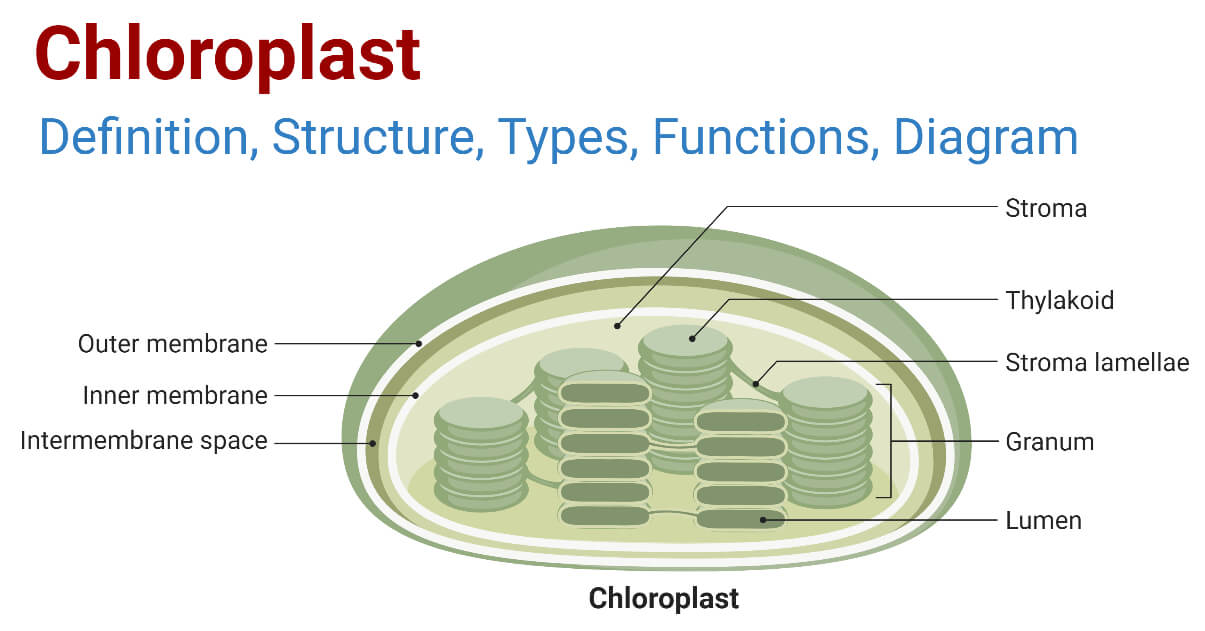
Chloroplasts are double-membrane plastids found mainly in mesophyll cells. A typical leaf cell contains 30–40 chloroplasts. Each chloroplast has the following compartments:
| Structure | Description | Function |
|---|---|---|
| Outer membrane | Smooth, permeable to small molecules | Boundary; allows CO₂, O₂ exchange |
| Inner membrane | Selectively permeable | Controls flow of metabolites |
| Stroma | Fluid matrix containing DNA, ribosomes, enzymes | Site of Calvin cycle (dark reactions) |
| Thylakoid | Flattened sacs with embedded pigments | Site of light reactions |
| Granum (pl. grana) | Stack of thylakoids | Increases surface area for light capture |
| Stroma lamellae | Thylakoids connecting grana | Maintain proton gradient continuity |
6.4 Photosynthetic Pigments
| Pigment | Colour Reflected | Absorption Peaks | Role |
|---|---|---|---|
| Chlorophyll a | Blue-green | 430 nm, 662 nm | Primary pigment; reaction centre of PS I & II |
| Chlorophyll b | Yellow-green | 453 nm, 642 nm | Accessory — broadens light capture |
| Carotenoids (carotene, xanthophyll) | Yellow / orange | ~450 nm | Accessory; photoprotection from excess light |
6.5 Two Stages of Photosynthesis — Overview
Both stages run together in daylight; the dark reaction is "dark" only in the sense that it does not directly need photons. [NCBI]
A. Classwork
- Write the overall balanced equation for photosynthesis using 12 H₂O.
- Label a diagram of a chloroplast (outer membrane, inner membrane, stroma, granum, thylakoid, lumen).
- State why chlorophyll a appears green although it absorbs at 430 nm and 662 nm.
B. Practical / Take-Home
- Pigment separation: Extract pigments from a fresh leaf using ethanol; perform paper chromatography. Identify chlorophyll a, b, and carotenoids by their Rf values.
- Essay (300–500 words): "Why life on Earth depends on a 0.04% gas (CO₂) and a green pigment."
Light Reactions & Photolysis of Water
Photosystems I & II · Z-scheme · Photophosphorylation · Water splitting
Learning Outcomes
- Describe the structure and role of photosystems I and II
- Explain non-cyclic and cyclic photophosphorylation (Z-scheme)
- State the equation and significance of photolysis of water (Hill reaction)
- Identify the products of the light reactions
7.1 Two Photosystems
| Feature | Photosystem II (PS II) | Photosystem I (PS I) |
|---|---|---|
| Reaction-centre chlorophyll | P680 (absorbs at 680 nm) | P700 (absorbs at 700 nm) |
| Discovered first? | Numbered 2 but discovered second | Numbered 1; discovered first |
| Electron source | H₂O (via photolysis) | PS II via electron transport chain |
| Final electron acceptor | Plastoquinone (PQ) | NADP⁺ → NADPH |
| Released gas | O₂ | None |
7.2 Photolysis of Water (Hill Reaction)
At PS II, light energy drives the splitting of water molecules — a process called photolysis or the Hill reaction. It supplies the electrons used to reduce P680⁺, releases molecular oxygen, and contributes protons (H⁺) to the thylakoid lumen.
- 2 H₂O —light, Mn cluster→ 4 H⁺ + 4 e⁻ + O₂
- Catalysed by the oxygen-evolving complex (OEC) containing four manganese (Mn) atoms.
- Provides the only source of atmospheric O₂ of biological origin.
7.3 The Z-Scheme — Non-Cyclic Photophosphorylation
7.4 Cyclic vs. Non-Cyclic Photophosphorylation
| Feature | Non-cyclic | Cyclic |
|---|---|---|
| Photosystems | Both PS I and PS II | Only PS I |
| Electron path | H₂O → PS II → PS I → NADPH | Loops back to PS I |
| Products | ATP, NADPH, O₂ | ATP only |
| Function | Main energy and reductant supply | Extra ATP when NADPH is in surplus |
7.5 Summary of Light-Reaction Products
- ATP — chemical energy currency.
- NADPH — reducing power.
- O₂ — by-product, released to atmosphere.
A. Classwork
- Draw and label the Z-scheme; mark where ATP and NADPH are formed.
- Write the equation for photolysis of water and identify the metal cluster involved.
- State two differences between cyclic and non-cyclic photophosphorylation.
B. Take-Home
- Carry out the Hill reaction demonstration: dichlorophenol-indophenol (DCPIP) decolourised by isolated chloroplasts in light. Record colour change times in light vs. dark and explain.
- Write a structured 1-page report.
Calvin Cycle (Dark Reactions)
Carboxylation · Reduction · Regeneration of RuBP · C3, C4, CAM
Learning Outcomes
- Describe the three phases of the Calvin cycle
- Identify RuBisCO, RuBP, 3-PGA, G3P and their roles
- Explain how ATP and NADPH from light reactions are used
- Compare C3, C4 and CAM pathways
8.1 Overview
The Calvin cycle (also called the C3 pathway, dark reaction, or Calvin–Benson cycle) takes place in the chloroplast stroma. It uses the ATP and NADPH made in the light reactions to fix atmospheric CO₂ into a stable carbohydrate, glyceraldehyde-3-phosphate (G3P), from which glucose, sucrose and starch are synthesised.
8.2 Three Phases of the Calvin Cycle
- Per 1 glucose (2 × G3P): 6 CO₂ + 18 ATP + 12 NADPH consumed.
- RuBisCO is the most abundant enzyme on Earth.
8.3 Diagram of the Calvin Cycle
8.4 C3, C4 and CAM Pathways
| Feature | C3 | C4 | CAM |
|---|---|---|---|
| First fixed product | 3-PGA (3 C) | OAA (4 C) | OAA at night |
| Initial enzyme | RuBisCO | PEP carboxylase | PEP carboxylase |
| Anatomy | Mesophyll only | Kranz: mesophyll + bundle sheath | Single cell, time-separated |
| Climate | Cool, moist | Hot, sunny | Arid (succulents) |
| Examples | Wheat, rice, soybean | Maize, sugarcane, sorghum | Cactus, pineapple, agave |
| Photorespiration | High | Suppressed | Suppressed |
A. Classwork
- List the three phases of the Calvin cycle in order with the key enzyme of phase 1.
- Calculate the number of ATP and NADPH needed to synthesise one molecule of glucose.
- Explain why RuBisCO is described as the most abundant protein on Earth.
B. Take-Home Assignment
- Compare C3, C4 and CAM plants in a table; give two crop examples of each adapted to West Africa.
- Short essay (400 words): "Why C4 plants outperform C3 plants under high light and high temperature."
Translocation of Manufactured Food
Phloem structure · Pressure-flow hypothesis · Source–sink · Loading & unloading
Learning Outcomes
- Define translocation and identify the tissue involved
- Describe phloem composition: sieve elements and companion cells
- Explain the pressure-flow (Münch) hypothesis of phloem transport
- Distinguish source from sink and outline loading and unloading
- Compare xylem and phloem transport
9.1 What is Translocation?
Translocation is the long-distance transport of manufactured food (mainly sucrose, but also amino acids and hormones) from a source (where it is made or stored) to a sink (where it is used or stored). It occurs in the phloem.
9.2 Phloem Anatomy
| Cell | Living? | Role |
|---|---|---|
| Sieve-tube element | Yes (no nucleus) | Conducts sap; sieve plates between cells |
| Companion cell | Yes (full organelles) | Provides ATP and proteins; loads sucrose |
| Phloem fibre | No (sclerenchyma) | Mechanical support |
| Phloem parenchyma | Yes | Storage |
9.3 Source and Sink
| Source | Sink |
|---|---|
| Mature photosynthetic leaves | Growing roots, fruits, seeds, tubers |
| Storage organs in spring (when mobilising starch) | Same organs in summer (when storing) |
The same organ can switch between source and sink during the season. Example: a potato tuber is a sink in summer (storing starch) but a source in spring (when sprouting and supplying sugars to new shoots).
9.4 Pressure-Flow Hypothesis (Ernst Münch, 1930)
The continuous gradient in pressure between source and sink keeps the phloem sap flowing. [Georgia Tech]
9.5 Xylem vs. Phloem
| Feature | Xylem | Phloem |
|---|---|---|
| Cells | Dead vessels & tracheids | Living sieve-tube + companion cells |
| Substance moved | Water + minerals | Sucrose, amino acids, hormones |
| Direction | Upward (one way) | Source → sink (any direction) |
| Driving force | Transpiration pull (negative pressure) | Pressure-flow (positive pressure) |
| Energy | Passive | Active loading at source (ATP) |
A. Classwork
- Define translocation, source and sink in your own words.
- List four differences between xylem and phloem transport.
- Identify the source and sink of: a sprouting potato; a ripening mango; a flowering cassava.
B. Take-Home Assignment
- Ringing experiment essay: Describe Malpighi's classic ringing experiment on a tree trunk. Explain the observation in light of phloem function.
- Diagram and annotate the four steps of the pressure-flow mechanism.
Nitrate Reduction & Amino-Acid Synthesis
Nitrate reductase · Nitrite reductase · GS–GOGAT · Transamination
Learning Outcomes
- Outline how plants assimilate nitrate from the soil
- Describe the steps of nitrate → nitrite → ammonium reduction
- Explain the GS–GOGAT cycle for ammonium assimilation
- Describe transamination as a route to other amino acids
10.1 Why Nitrogen Matters
Nitrogen is required for amino acids, proteins, nucleic acids, chlorophyll and many cofactors. Although ~78% of the atmosphere is N₂, plants cannot use the gas directly. They take up nitrate (NO₃⁻) or ammonium (NH₄⁺) from the soil and reduce nitrate to ammonium before incorporating it into organic molecules. [MicrobeNotes]
10.2 Nitrate Reduction — Two Enzymatic Steps
10.3 Ammonium Assimilation — The GS–GOGAT Cycle
The cycle continually rebuilds glutamate while channelling fixed nitrogen into glutamine — the gateway amino acid for all other amino acids and nucleotides.
10.4 Transamination — From Glutamate to Other Amino Acids
Other amino acids are made by transamination: the –NH₂ group of glutamate is transferred to a keto-acid acceptor by aminotransferases (transaminases), generating a new amino acid and α-ketoglutarate.
| Keto-acid acceptor | Amino acid produced |
|---|---|
| Pyruvate | Alanine |
| Oxaloacetate | Aspartate |
| 3-Phosphoglycerate | Serine |
| 2-Oxoglutarate | Glutamate (cycle) |
10.5 Why Mo and Fe Matter Here
- Molybdenum (Mo) — cofactor of nitrate reductase. Mo deficiency → nitrate accumulates, plant becomes effectively N-deficient even when nitrate is plentiful.
- Iron (Fe) — component of haem in NR and Fe–S clusters in NiR.
- Manganese (Mn) and ferredoxin pool — link photosynthesis to nitrogen assimilation.
A. Classwork
- Write the two reduction reactions catalysed by NR and NiR with their cofactors.
- Draw a flow chart from soil NO₃⁻ to glutamate via GS–GOGAT.
- Define transamination and give one example.
B. Take-Home
- Mini-research (1–1.5 pages): "Why molybdenum deficiency mimics nitrogen deficiency."
- Construct a concept map linking N source → NR → NiR → GS → GOGAT → transamination → protein.
Aerobic Respiration
Glycolysis · Krebs cycle · Electron transport chain · ATP yield
Learning Outcomes
- Define respiration and contrast it with photosynthesis
- Describe the four stages of aerobic respiration and their locations
- State the ATP and NADH yields per stage
- Explain the importance of respiration for plant growth
11.1 What is Respiration?
Respiration is the controlled oxidation of food (mainly glucose) to release energy stored as ATP. Aerobic respiration uses oxygen as the final electron acceptor. The overall equation:
- C₆H₁₂O₆ + 6 O₂ → 6 CO₂ + 6 H₂O + ~32 ATP
- ΔG° ≈ −2870 kJ/mol — most lost as heat, ~40% captured in ATP.
11.2 Photosynthesis vs. Respiration
| Feature | Photosynthesis | Respiration |
|---|---|---|
| Reactants | CO₂ + H₂O + light | Glucose + O₂ |
| Products | Glucose + O₂ | CO₂ + H₂O + ATP |
| Energy | Stored | Released |
| Site | Chloroplast | Cytoplasm + mitochondrion |
| When | Daylight | Day & night |
11.3 Four Stages of Aerobic Respiration
| Stage | Location | Inputs | Outputs (per glucose) |
|---|---|---|---|
| 1. Glycolysis | Cytoplasm | Glucose, 2 ATP, 2 NAD⁺ | 2 Pyruvate, 4 ATP (net 2), 2 NADH |
| 2. Pyruvate oxidation (link reaction) | Mitochondrial matrix | 2 Pyruvate, 2 NAD⁺, 2 CoA | 2 Acetyl-CoA, 2 CO₂, 2 NADH |
| 3. Krebs (citric acid) cycle | Mitochondrial matrix | 2 Acetyl-CoA | 4 CO₂, 6 NADH, 2 FADH₂, 2 ATP |
| 4. Electron transport & oxidative phosphorylation | Inner mitochondrial membrane | 10 NADH, 2 FADH₂, 6 O₂ | 6 H₂O, ~26 ATP |
Total per glucose: ~32 ATP, 6 CO₂, 6 H₂O. [NCBI]
11.4 Diagram — Respiration Overview
11.5 Significance for Plants
- Respiration provides ATP for active uptake of minerals, protein synthesis, growth and movement.
- It supplies carbon skeletons (e.g., α-ketoglutarate, oxaloacetate) for amino-acid synthesis (link with Week 10).
- It releases heat that contributes to flower thermogenesis (e.g., Arum, Symplocarpus) to volatilise scents.
A. Classwork
- Write the overall equation for aerobic respiration.
- State the location, net ATP, and net NADH for each of the four stages.
- Explain why O₂ is essential despite not appearing until the last step.
B. Practical / Take-Home
- Germinating seed respiration: Use a thermos flask with germinating bean seeds + thermometer; record temperature rise over 24 h. Compare with boiled (dead) seeds. Explain.
- Short essay: "Plants respire all day and all night; why does this not exhaust their food?"
Anaerobic Respiration in Plants
Fermentation · Ethanol & lactate · Flooded soils · Comparison with aerobic
Learning Outcomes
- Define anaerobic respiration and fermentation in plants
- Write the equations for ethanol and lactate fermentation
- Compare aerobic and anaerobic respiration in ATP yield
- Explain anaerobic adaptations (e.g., rice, flood-tolerant crops)
12.1 When Plants Respire Without Oxygen
When O₂ is limited — in flooded soils, deep within bulky tissues, or in submerged seeds — plants switch to anaerobic respiration (fermentation). Glycolysis still occurs, but pyruvate is no longer fed into the Krebs cycle; instead it is reduced to ethanol or lactate to regenerate NAD⁺ so glycolysis can continue.
12.2 Two Routes
| Pathway | Equation | Where |
|---|---|---|
| Ethanol fermentation | Pyruvate → acetaldehyde + CO₂; acetaldehyde + NADH → ethanol + NAD⁺ | Most plants under hypoxia; yeast |
| Lactate fermentation | Pyruvate + NADH → lactate + NAD⁺ | Brief or partial hypoxia; some root tips; animal muscle |
- C₆H₁₂O₆ → 2 C₂H₅OH + 2 CO₂ + 2 ATP (ethanol fermentation)
12.3 Aerobic vs. Anaerobic Respiration
| Feature | Aerobic | Anaerobic |
|---|---|---|
| O₂ required? | Yes | No |
| Final product of glucose | CO₂ + H₂O | Ethanol + CO₂ (or lactate) |
| ATP yield | ~32 per glucose | 2 per glucose |
| Site | Cytoplasm + mitochondrion | Cytoplasm only |
| Heat | Moderate | Low |
12.4 Adaptations to Anaerobic Conditions
- Rice (Oryza sativa): aerenchyma tissue carries O₂ from leaves to submerged roots.
- Mangrove pneumatophores: aerial breathing roots above tidal mud.
- Cypress knees in swamp species.
- Tolerant species accumulate alanine rather than ethanol to avoid self-poisoning.
12.5 Practical Significance
| Application | Use |
|---|---|
| Bread & alcohol industry | Yeast (and plant-cell ethanol fermentation) produce CO₂ and ethanol. |
| Silage making | Lactic-acid fermentation preserves animal feed. |
| Storage of grains/tubers | Reducing O₂ in airtight silos slows respiration; but excess hypoxia ruins quality. |
A. Classwork
- Write the overall equation for ethanol fermentation in plants.
- State four differences between aerobic and anaerobic respiration.
- Explain how rice survives in waterlogged paddy fields.
B. Take-Home Practical
- Place yeast in a glucose solution inside a sealed flask connected to limewater. Record the time taken for limewater to turn milky and explain.
- Optional: repeat with germinating pea seeds kept in nitrogen gas to simulate hypoxia.
Plant Growth & Its Measurement
Meristems · Growth zones · Auxometer/arc indicator · Sigmoid curve · Growth analysis
Learning Outcomes
- Define plant growth and identify the meristems involved
- Describe zones of cell division, elongation and maturation
- Use simple instruments (auxometer, horizontal microscope) to measure growth
- Interpret a sigmoid growth curve and growth indices (RGR, NAR)
13.1 What is Plant Growth?
Growth is the irreversible increase in size, mass or number of cells in a plant, driven by cell division and cell expansion. Unlike animals, plants grow throughout their life through specialised tissues called meristems. [NCBI]
13.2 Types of Meristems
| Meristem | Location | Result |
|---|---|---|
| Apical | Tips of shoots and roots | Primary growth (length) |
| Lateral (cambium) | Cylindrical layers in stems and roots of dicots | Secondary growth (girth) — absent in most monocots |
| Intercalary | Bases of internodes (e.g., grasses) | Rapid stem elongation; allows regrowth after grazing |
13.3 Three Growth Zones at a Root or Shoot Tip
13.4 Methods of Measuring Growth
| Method | Principle | What it measures |
|---|---|---|
| Direct measurement (ruler/calipers) | Increase in length, diameter | Stem height, leaf length, root length |
| Auxometer / Arc indicator | Pivoting pointer amplifies tip growth | Rapid (minutes–hours) shoot elongation |
| Horizontal microscope | Cross-hairs track tip movement against scale | Very small or slow growth |
| Crescograph (Bose) | Magnifies movement up to 10⁶× | Minute changes in length |
| Fresh / dry mass | Weighing | Total biomass over time |
| Leaf area (graphical or planimeter) | Area calculation | Total photosynthetic surface |
The classic plant growth curve is sigmoid: a slow lag phase, an exponential log phase (most rapid increase), and a stationary phase (growth tapers as resources or developmental signals limit it).
13.5 Quantitative Growth Analysis
- Relative Growth Rate (RGR) = (ln W₂ − ln W₁) / (t₂ − t₁) — mass added per unit existing mass per unit time.
- Net Assimilation Rate (NAR) = increase in mass per unit leaf area per unit time — photosynthetic efficiency.
- Leaf Area Ratio (LAR) = leaf area / total dry mass.
- RGR = NAR × LAR.
A. Classwork
- Distinguish apical, lateral and intercalary meristems with one example each.
- Sketch the sigmoid growth curve and label the lag, log and stationary phases.
- Calculate the RGR of a plant whose dry mass rose from 5 g to 20 g in 30 days.
B. Practical Assignment (lab + field)
- Grow 10 maize seedlings; measure shoot height and leaf number every 2 days for 3 weeks. Tabulate, plot a growth curve, identify the phases, and calculate RGR.
- Construct a simple auxometer using a pin, lever, and pulley; demonstrate growth of a Coleus shoot over 24 h.
Plant Movements
Tropisms · Thigmotropism · Nastic movements · Hormonal control
Learning Outcomes
- Define tropism and nastic movement and distinguish them
- List the major tropisms with examples
- Explain thigmotropism and tendril coiling
- Describe nastic movements and the role of the pulvinus
- Outline hormonal control of movement (auxin, ABA)
14.1 Two Big Classes of Plant Movement
| Feature | Tropism | Nastic |
|---|---|---|
| Direction | Determined by stimulus direction | Independent of stimulus direction |
| Mechanism | Differential growth | Reversible turgor changes (osmotic) |
| Reversible? | No (growth is permanent) | Yes |
| Example | Shoot bending toward light | Mimosa leaf folding on touch |
14.2 Tropisms — Directional Growth Responses
| Tropism | Stimulus | Example |
|---|---|---|
| Phototropism | Light | Shoot bends toward light (positive); roots away (negative) |
| Geotropism (Gravitropism) | Gravity | Roots grow downward (positive); shoots upward (negative) |
| Hydrotropism | Water | Roots grow toward moisture |
| Chemotropism | Chemicals | Pollen tube grows toward ovule |
| Thigmotropism | Touch / mechanical contact | Tendrils of cucumber, passion fruit, grapevine coil around supports |
| Thermotropism | Temperature | Some flowers track warmth |
| Traumatotropism | Wounding | Roots grow away from injured side |
Most tropic responses are mediated by auxin (IAA) migrating to the shaded or lower side of an organ, where it promotes elongation, causing the curvature. [Britannica]
14.3 Thigmotropism — The Touch Response
14.4 Nastic Movements
| Type | Stimulus | Example |
|---|---|---|
| Thigmonasty | Touch | Mimosa pudica leaf folding; Venus fly-trap closure |
| Photonasty | Light intensity | Dandelion / morning glory opening at dawn |
| Nyctinasty | Day/night cycle | Prayer plant (Maranta) leaves fold up at night |
| Thermonasty | Temperature | Tulip / crocus flower opens with warmth |
| Chemonasty | Chemicals | Sundew tentacles bend on contact with prey |
| Seismonasty | Vibration / shock | Mimosa leaf collapse on touch |
14.5 Plant Hormones in Movement & Growth (Quick Reference)
| Hormone | Main role(s) |
|---|---|
| Auxin (IAA) | Phototropism, gravitropism, apical dominance, root initiation |
| Gibberellins (GA) | Cell elongation, stem growth, breaking seed dormancy |
| Cytokinins | Cell division, delay of senescence |
| Ethylene | Fruit ripening, leaf abscission |
| Abscisic acid (ABA) | Stomatal closure, dormancy, stress response |
A. Classwork
- State two clear differences between tropic and nastic movements.
- List five tropisms with their stimuli and one example each.
- Explain the role of auxin in shoot phototropism.
B. Practical / Take-Home
- Phototropism demo: Place a bean seedling on a windowsill with light only from one direction; record the angle of curvature daily for a week and explain.
- Mimosa investigation: Time the leaf-folding response of Mimosa pudica after a single touch and after repeated touches. Discuss any habituation observed.
- Essay (300–500 words): "How plants 'see', 'feel' and 'choose' — the physiology of plant movement."
Excretion in Plants & Course Synthesis
Removal of waste · Secondary metabolites · Integration of all topics · Exam prep
Final Learning Outcomes
- Describe how plants excrete gases, water and solid waste
- Identify common secondary metabolites that act as excretory products
- Integrate all course themes — absorption, photosynthesis, translocation, respiration, growth, movement, excretion
- Prepare effectively for the BIO 221 examination
15.1 Excretion in Plants — Why So Quiet?
Plants do not have specialised excretory organs comparable to animal kidneys. Their metabolism produces less nitrogenous waste because nitrogen is recycled into amino acids. Most of what would be "waste" is either re-used, deposited as inert deposits, or released through diffusion. [Britannica]
15.2 Routes of Excretion
| Substance | Route of removal |
|---|---|
| O₂ (from photosynthesis) | Diffuses out through stomata, lenticels, root cell walls |
| CO₂ (from respiration) | Diffuses out through stomata and lenticels |
| Excess water | Transpiration (evaporation) and guttation (liquid drops via hydathodes) |
| Mineral salts | Crystallised as raphides or cystoliths inside vacuoles, or stored in older leaves shed at leaf-fall |
| Organic acids, tannins, alkaloids | Stored in vacuoles, bark, heart-wood; also leached by rain |
| Resins, latex, gums, mucilage | Exuded passively via specialised ducts after wounding (e.g., rubber tree, pine, papaya) |
Many excretory products serve secondary roles — alkaloids deter herbivores, resins seal wounds, latex traps insects, tannins resist decay.
15.3 Important Plant Secondary Products
| Class | Examples | Significance |
|---|---|---|
| Alkaloids | Caffeine, nicotine, quinine, morphine | Defence; major medicinal value |
| Tannins | Found in oak, mangrove bark | Antimicrobial; leather industry |
| Resins | From pine, frankincense | Wound sealing; varnish |
| Latex | Hevea (rubber), Carica (papaya) | Defence; commercial rubber |
| Essential oils | Citrus, mint, eucalyptus | Pollinator attraction; aroma industry |
| Crystals (Ca-oxalate) | Raphides in cocoyam, dieffenbachia | Sequester calcium; deter herbivores |
15.4 Course Integration — The Big Picture
| Topic | Connects to | Why it matters |
|---|---|---|
| Water absorption | Transpiration, mineral uptake | Without uptake there is no transport stream |
| Photosynthesis | Translocation, respiration | Source of organic carbon for the entire plant and ecosystem |
| Mineral nutrition | Photosynthesis (Mg, Fe), N assimilation (Mo) | Limits productivity |
| Translocation | Photosynthesis, growth, storage | Distributes assimilates to non-photosynthetic tissues |
| Respiration | All energy-requiring processes | Uses sugars; provides ATP & carbon skeletons |
| Growth & movement | Hormonal regulation | Outcome of internal physiology + environmental cues |
| Excretion | Photosynthesis, respiration, defence | Removes by-products and produces useful secondary metabolites |
15.5 Examination Preparation
- Wk 1: Define plant physiology; explain plants as primary producers.
- Wk 2–3: Water potential equation; pathways of uptake; cohesion-tension; factors affecting transpiration.
- Wk 4–5: 14 mineral elements; symptoms of deficiency in N, P, K, Ca, Mg, Fe, Zn.
- Wk 6–8: Equation of photosynthesis; chloroplast structure; Z-scheme; photolysis; Calvin cycle phases; C3/C4/CAM.
- Wk 9: Pressure-flow hypothesis; xylem vs. phloem.
- Wk 10: NR, NiR, GS-GOGAT; transamination.
- Wk 11–12: Stages of aerobic respiration; ATP yields; ethanol fermentation; aerobic vs. anaerobic.
- Wk 13: Meristems; growth zones; sigmoid curve; RGR.
- Wk 14: Tropism vs. nastic; auxin in phototropism; pulvinus mechanism.
- Wk 15: Routes of plant excretion; major secondary metabolites.
A. Classwork
- List four routes by which plants excrete waste.
- Identify three commercially important plant secondary metabolites.
- Draw a single integrated diagram showing water uptake → transpiration → photosynthesis → translocation → respiration in the same plant.
B. Final Course Project
- Choose one local crop (e.g., cassava, maize, rice, tomato, cocoa, oil palm).
- Write a 1500-word case study covering: water relations, mineral needs, photosynthetic pathway (C3/C4/CAM), translocation, key respiration considerations, growth pattern, hormonal/movement response, and notable excretory products.
- Include at least two diagrams and three primary references.
You have completed BIO 221 Plant Physiology — from soil water and stomata to chloroplasts, sugars, sap streams, growth and movement. Plants quietly do most of the work that keeps our planet alive. Carry that perspective into your next course.